Fiche E11
Luxation / instabilité antérieure
Épidémiologie
23,1 par 100 000 en Ontario, 98,3 chez les hommes de 20 ans ou moins ; 95 % des luxations sont antérieures.185,186
Présentation clinique
Bras en adduction et rotation interne après abduction-RE forcée, ou après une chute chez l'aîné.187,188
Examen physique
Nerf axillaire ; après réduction, appréhension (Se 72 %, Sp 96 %) et recentrage (Se 81 %, Sp 92 %) ; abduction impossible après 35 ans : rupture de coiffe.189,190,191
Physiopathologie
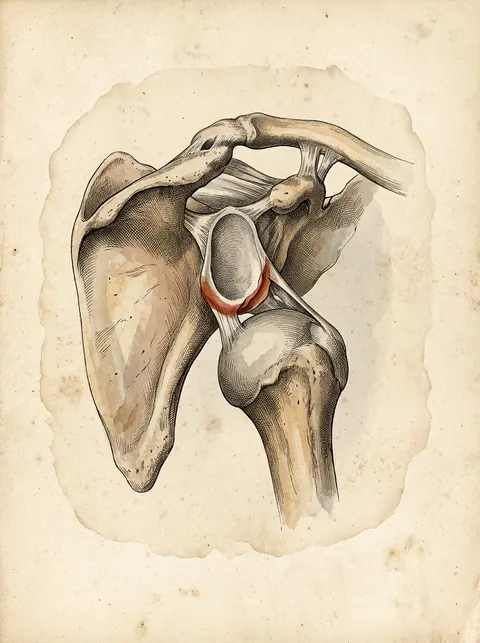
Lésion de Bankart (labrum antéro-inférieur) et encoche de Hill-Sachs (tête postéro-supérieure).188,192
Diagnostic différentiel
Luxation postérieure, fracture de l'humérus proximal ou du tubercule majeur, rupture aiguë de coiffe.193,194
Investigations
Face et axillaire avant et après réduction ; échographie ou IRM de la coiffe après 40 ans.187,195
Traitement
Écharpe ≤ 1 semaine ; physiothérapie structurée non supérieure aux conseils (ARTISAN) ; stabilisation précoce chez le jeune (récidive 6,3 % contre 46,6 %).196,186,198
Pronostic
Récidive sans chirurgie : 51 % à 15–20 ans, 36 % à 21–40 ans, 11 % à 41–60 ans.188

Références
- Leroux T et al. The American Journal of… 2014
- BMJ (Clinical Research Ed ) 2024
- Watson S et al. Sports Health 2016
- Cordula Braun et al. Cochrane Database of… 2019
- The Journal of Bone and Joint Surgery American Volume 2006
- Galvin JW et al. Current Reviews in… 2017
- The Journal of Bone and Joint Surgery American Volume 1988
- Tiefenboeck TM et al. Archives of Orthopaedic and… 2020
- Lo IK et al. The American Journal of… 2004
- The Journal of Bone and Joint Surgery American Volume 2012
- Gutkowska O et al. Neurosurgical Review 2020
- The Journal of Bone and Joint Surgery American Volume 2010
- Belk JW et al. The American Journal of… 2023