Fiche H2
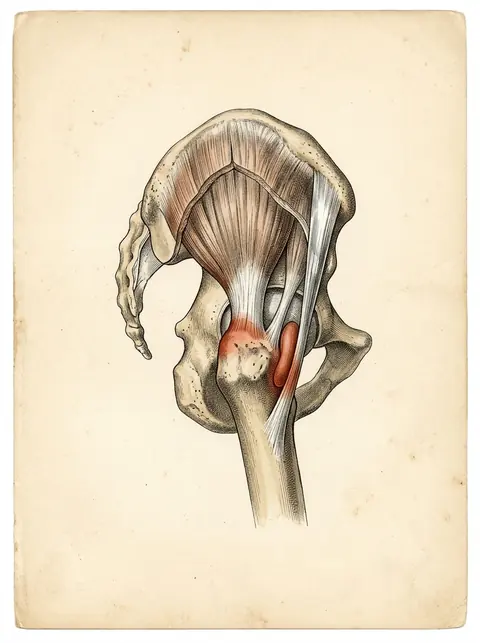
Syndrome douloureux du grand trochanter
Épidémiologie
17,6 % à 50–79 ans (femmes 23,5 %, hommes 8,5 %).199
Présentation clinique
Douleur latérale en décubitus latéral, dans les escaliers, debout.200,201
Examen physique
Palpation du trochanter Se 80 % (négative : exclut) ; douleur en 30 secondes d'appui unipodal Sp 100 % ; FABER avec douleur latérale Se 83 %, Sp 90 % contre coxarthrose.202,203
Physiopathologie
Compression des tendons moyen et petit fessiers en adduction de hanche.203
Diagnostic différentiel
Radiculopathie ou sténose lombaire, coxarthrose, conflit, fracture de stress.204
Investigations
Clinique ; anomalies tendineuses fréquentes à l'IRM sans symptômes.205,206
Traitement
Éducation et exercice : succès 77 % contre 58 % (infiltration) et 29 % (attente) à 8 semaines ; 78 %, 57 % et 52 % à 1 an (LEAP).207
Pronostic
Symptômes persistant jusqu'à 5 ans chez 29 %.208

Références
- Segal NA et al. Archives of Physical Medicine… 2007
- Furia JP et al. The American Journal of… 2009
- Chamberlain R American Family Physician 2021
- Grimaldi A et al. British Journal of Sports… 2017
- Z ) 2015
- Drummond J et al. Archives of Orthopaedic and… 2016
- Rossignol-Aveline A et al. Pain Research & Management 2026
- Grimaldi A et al. Archives of Orthopaedic and… 2025
- BMJ (Clinical Research Ed ) 2018
- Patricio Cordeiro TT et al. Scientific Reports 2024