Fiche D23
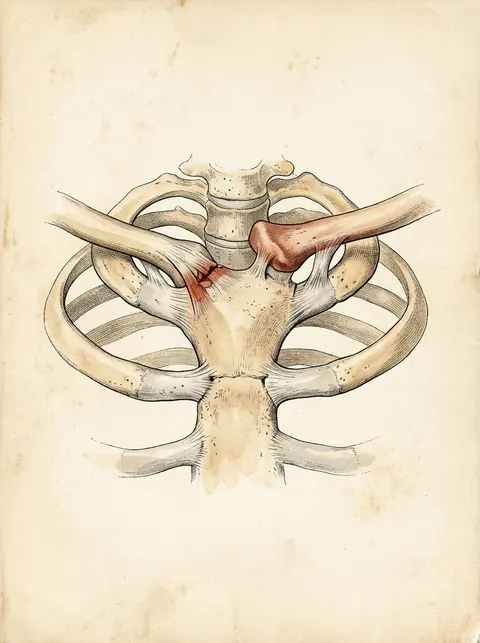
Entorse ou luxation sterno-claviculaire
Épidémiologie
1–3 % des lésions de la ceinture scapulaire ; antérieure dans 73–95 %.373,374
Présentation clinique
Antérieure : force indirecte sur l'épaule ; postérieure : choc direct ; dyspnée, dysphagie, voix rauque = alerte.375,376
Examen physique
Saillie médiale de la clavicule (antérieure) ou dépression parasternale (postérieure).377
Physiopathologie
Stabilité purement ligamentaire ; avant la fusion de la physe médiale (22–25 ans), fracture physaire plutôt que luxation.374,378
Diagnostic différentiel
Fracture physaire, fracture de la clavicule, arthrose, SAPHO.379,377,311
Investigations
TDM, ± angio-TDM.380
Traitement
Entorse : écharpe 2–3 semaines ; luxation antérieure : traitement fermé ; postérieure : réduction au bloc en urgence.298,375
Pronostic
Postérieure : compression médiastinale dans 30 %, mortalité 3–4 % ; fonction complète chez 92 % après traitement fermé.376,298

Références
- Kapoor U et al. The American Journal of… 2026
- Somberg O et al. European Journal of Trauma… 2026
- Simon LM et al. American Family Physician 2023
- Damschen J et al. The American Journal of… 2023
- Martetschläger F et al. The American Journal of… 2014
- Tepolt F et al. The American Journal of… 2014
- Kim WG et al. Pediatric Radiology 2023
- Jurik AG Rheumatology International 1992
- The Journal of Bone and Joint Surgery American Volume 2026
- Z ) 2018